Tel: 07764254881
Gower Acupuncture
  • Home
  • Pain
    • Headache & Migraine
    • Back Pain
    • Stress & Anxiety
  • Booking & Cost
  • About Tim
    • Reviews
    • Acupuncture Treatment Details
  • Contact
  • News
  • Click to open the search input field Click to open the search input field Search
  • Menu Menu

Acupuncture for Anxiety

January 26, 2026/0 Comments/in Stress & Anxiety/by Tim W

Acupuncture For Anxiety


Treatment for anxiety is not a quick fix. I frequently find anxiety is something that has deep roots, often traced back to childhood. Behavioural patterns become entrenched, like a well trodden path through a field of long grass.

Look at the image at the top of this page. A path leads from the bottom of the page to the top. Imagine this to be a neural pathway in the brain – representing a behavioural pattern or habit. As you approach the field above you see only one way through the field of grass. You could choose to walk anyway through the grass – create your own path. But its much easier to follow the well trodden path.

If that path represents a negative behavioural pattern this is not good. You need to create a new path – a positive behavioural pattern. This involves trampling a new route through the grass – maybe diagonally off to the right of the picture. The grass is long and well established so this won’t be easy.

You travel this path once – the grass gets trampled a little bit. The next day you approach the field again. Two paths are available – one heavily trampled the other lightly trampled. You have a decision to make again. One path is easy still. The other difficult, but slightly more easy now. The positive behavioural patterns must be reinforced, the difficult path travelled consistently until it becomes the default option. A new healthy habit.

This ability to adopt new behaviours is known as functional neuroplasticity. There are permanent changes in the synapses following self development and learning. I think its hugely exciting. It means that if you put the work in you can change the way you behave and interact.

How Does this Neuro-plasticity Apply To acupuncture?

So this is all very interesting but how does it related to acupuncture treatment for anxiety? Its thought the calmness that follow an acupuncture treatment is due to calming of the sympathetic nervous system. On its own this can be enough for people who suffer anxiety with no obvious trigger. If anxiety has a trigger – social situations, driving, work, going outside then these activities need to be carried out whilst in a calmer state. You need to be exposed, to a certain degree, to the trigger, to create these new neural pathways, new ways of behaving when exposed to stress.

  • Did you know?
    Research from University of York found acupuncture better than standard NHS treatment for depression. It faired even better when paired with talking therapies such as counselling or psychology.

But why are so many people feeling anxious nowadays?

This Anxious Generation

Our current “always on” society gives us little time to just escape and “be”. Even a quiet walk in the country or by the sea can be interrupted by Facebook updates and text messages. This downtime is important for our health and creativity. Studies have shown that the unconscious mind is better at problem solving than the conscious mind.

Salvador Dali recognised this. Apparently, he would doze with a key in hand rested over a plate or glass. At the point where he was about to fall asleep his fingers naturally relaxed, dropping the key onto the glass. This would wake him up in a state of partial sleep, unconscious activated. Primed to create another masterpiece.

Our brains need downtime to process the thoughts and emotions from the day. If you’re having a lot of vivid dreams and nightmares this may be a sign that you’re not creating enough time in your day to process emotions and difficulties. Depriving yourself of this downtime can lead to stress and anxiety, struggling to cope with the demands of a hectic daily life.

Historically stress is a short term response to a potential life threatening situation. In hunter-gatherer days this may have included being attacked by wild animals. In small doses and in the right situation stress is useful. Blood pressure rises as blood and oxygen are sent to the muscles and brain to improve function. The process of digestion and saliva production are shut down. After all who needs to digest food when your very survival is threatened?

These are useful responses to a short term threat.

Anxiety – Not All Bad?

Whilst chronic anxiety is not good or healthy, small doses of short term stress have been shown to boost the immune system, improve resilience and create new habits. Stress mildly challenges systems which adapt and becomes stronger as a result. You don’t get stronger without lifting weights, stressing and breaking down muscle. In a similar vein its very difficult to become resilient without exposing yourself to stressful situations. However, these situations must be limited and you must have time to recuperate.

Otherwise you can find yourself in a situation of chronic stress. Chronic stress is a destructive force. Stress raises cortisol a hormone that raises blood sugar levels and cuts off functions that are not needed in a fight or flight situation – digestion, immunity & repair. It doesn’t take a lot of imagination to understand the damage to your health resulting from high blood sugar levels and poorly functioning immune and digestive system.

Reframing anxiety as a force for good in your life to get you through short term “threats” can be useful. In its simplest form anxiety shows you care. If you’re anxious about your work, it shows you care about the quality of work you produce. Anxious about meeting people? Anxious about what the future may bring? Shows you care and value life.

Whilst this technique of reframing does not get rid of anxiety it can lessen its impact.

Reframing, mindfulness (in its many guises), breathing exercises, the 5 elements are all techniques I use in conjunction with acupuncture to help you feel better.

You can read more about acupuncture for anxiety treatment here.
 

How Acupuncture Treatment Works

January 22, 2026/0 Comments/in Pain/by Tim W

How Acupuncture Treatment Works

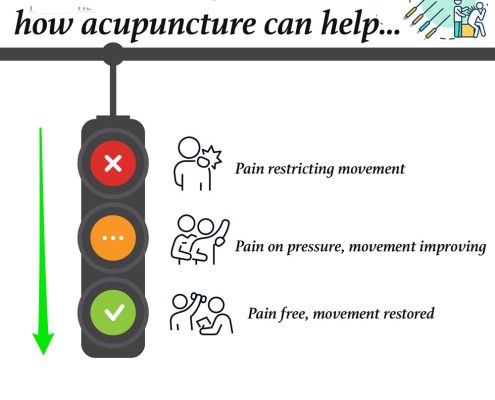
Acupuncture treatment for pain progresses in a reasonably predictable pattern from the red light phase of crippling pain through to the green light of getting your life back…

Traffic light system for acupuncture

  • The red stage of treatment. Pain is so acute that movement is problematic. And the pain may be impacting things you used to enjoy – sports, going out, mundane tasks at work or in the house. Acute or chronic its important to get your pain treated to stop it progressing. The earlier you catch it, the easier and quicker it is to treat.
  • The amber stage of treatment. As treatment progresses, pain levels drop, movement improves and many activities that were previously problematic become possible again. The pain may have gone, but often pressure on the previously painful area elicits pain. It’s important not to drop treatment too early as this latent pain can lurk, just waiting to be triggered again.
  • The green stage of treatment. The end game of treatment. Normal movement is restored. The area is no longer sensitive to touch or pressure. Previously painful activities can be enjoyed pain free.

How long it takes to progress from red to green, depends on numerous factors; age, health, chronicity of pain, mental health.
Acupuncturte doesn’t just work for pain, its also very effective at treating headaches and migraine and helping to ease stress and anxiety.

Fascia & Pain

January 22, 2026/0 Comments/in Health & Immunity/by Tim W

Fascia & Pain

Man stretching calf with foam roller
Until recently fascia was the thing that surgeons cut through to get to the interesting bits. It’s cast aside to access and assess the state of internal organs, muscles, nerves, blood vessels and tendons. Fascia itself is a thin layer of connective tissue, like a sausage skin, that sits under the skin and holds everything together. The most well known fascia is probably the plantar fascia, responsible for intense pain of plantar fasciitis. Its not just on the foot. It’s everywhere, all through the body.

Superficial fascia sits just under the skin and contains nerve fibres that detect pressure, temperature and movement. There’s also a deeper layer – usefully called deep fascia – which binds muscle, organs, blood vessels and more. This fascia is rich in fibres that sense position and movement (proprioception) and pain.

Fascia And Nerves…

Fascia is an important part of our structure. Whilst its very thin its not something to be ignored to get to the big prizes of muscle and internal organs. Most human fascia contains approximately 250 million nerve endings. Roughly the same as you’ll find in skin. If you suffer from chronic pain the number of these nerve fibres that sense pain can grows. Studies in rats have suggested the amount of nerve fibres may almost triple, which may explain why its so hard to treat chronic pain. Its thought that chronic inflammation causes the proliferation of these nerve fibres.

Are You as Healthy as you Think?

January 22, 2026/0 Comments/in Health & Immunity/by Tim W

Are You As Healthy As You Think?

The greatest wealth is health napkin with green smoothie
The World Health Organisation define Health as follows:
“Health is the state of complete physical, mental and social well-being and not merely the absence of disease”.

Using this definition, would you define yourself as healthy?

You could probably argue that the majority of the population are not healthy. Most people carry around niggling injuries, some form of anxiety and few are still unfortunately persecuted within society for race or beliefs.

As an acupuncturist and someone interested in holistic health; that is health in its entirety – health of the body, emotions and spirit – I am constantly amazed at how wealth is constantly valued over health. I don’t mean to say this in a judgmental way – like people who value wealth over health are somehow bad people. They aren’t. I watched first-hand as my own father prioritised work over health. He wasn’t necessarily focused on making lots of money, but he definitely had the quite common mindset, that health could be sacrificed to get the job done. This is wrong. There is nothing more important or satisfying as living a life free from disease, injury and discomfort.

I’m not saying that living a healthy life will guarantee you live to a century or insure you against serious disease. The human body is just too complex to give glib assurances. What I can say is it will improve your chances of not getting ill. And you’ll feel good. So why not make a healthy change now? Be it a change of diet, calorie restriction, more exercise, less stress. Nearly all these changes are enjoyable if you give the new routine a chance to lodge in and become habit.

If you’re on board here are some healthy things you can investigate to lead a healthier life.

1. Stand Up for your health

Studies by Karolinska University Hospital in Sweden have shown that getting off the couch and standing can be more beneficial than moderate exercise. Standing appears to lengthen telomeres – an indicator of health and longevity.

2. Floss

Or rather clean between the spaces in your teeth. Flossing has now been discredited and can harm the gums. Inter-dental cleaning , on the other hand, is allegedly good for your heart. Your mouth can harbor up to a thousand different types of bacteria. These bacteria can get into your bloodstream and cause inflammation and hardening of your arteries, leading to heart disease.

3. Sleep

Good sleep is essential for both your ability to think clearly and for your body and immune system. A study by Carnegie Mellon University in the US shows that people who get less than seven hours of sleep a night are more likely to get ill. The deep state of non-REM sleep is critical for effective functioning of the immune system. Conversely REM sleep, where your eyes are twitching and body muscles often paralysed, enables the brain to effectively process memories and emotions from the day. Disruption of this REM sleep can cause emotional, cognitive and memory impairment.

4. Slow Down

A tough one this. We all mostly lead a life we weren’t designed to cope with. The modern phenomena of being available 24/7 via phone, tablet, laptop means we have negligible downtime. Coupled to a work hard play hard ethic we constantly stress the sympathetic nervous system. This stimulates the brains survival mechanisms, which diverts energy away from essential bodily functions towards a “fight or flight” state. You may feel more alert and sometimes more energetic, but at the expenses of a well functioning digestive system, regular blood pressure and feeling of relaxation.
Counter this. Take some time out each week to just be; walk in nature, sit by the sea. You’ll feel relaxed and more importantly you’ll be dis-engaging the part of the nervous system that makes you feel stressed and ultimately leads to illness.

5. Fast

Research by university of California suggests that fasting for up to 3 days regenerates the immune system. Faulty white blood cells are destroyed and replaced by healthy cells. It’s not surprising when you look at nature – ill animals don’t generally eat.
Whilst the research is new the knowledge isn’t. Gandhi instinctively knew this 100 years ago – often fasting whenever illness struck. It allowed him to outlive many of his contemporaries in a time when disease often claimed the lives of the ill. Who knows how long he would have lived were he not assassinated aged 78. (Bear in mind that some research links intermittent fasting – ie restricting the amount of time you eat every day – to increase in heart disease).

6. Acupuncture

Whilst the common perception of acupuncture is for treating pain, nausea and migraines, it has also been shown to have a positive effect on the immune system. Tokyo University carried out research on professional cyclists and found that acupuncture boosts both cortisol and Salivary secretory immunoglobulin A (indicators of a healthy immune system) post vigorous exercise.

7. Detox

A tricky one this. No one product, diet, supplement will actually detox your body. Your organs, skin, liver and kidneys do a great job of this on their own. But you can support them all by lowering the load – eliminating alcohol, processed food and look into the possibility of fasting to give your digestion a rest.

8. Exercise

Exercise. Everyone knows that they should exercise but why?
a) Exercising speeds the blood flow through your blood vessels and so can stop clots building up and damaging your heart.
b) Exercising releases feel good endorphins which can keep low mood and depression at bay – both indicators of lower lifespan.
c) Gentle exercise keeps the joints mobile and muscles and tendons flexible.
d) The impact of exercise can help keep bones strong. Bones are a living organism and need some level of impact to remain strong into old age.

9. Nutrition

Try to eat 7 fruit and veg a day. Try to cut out all processed foods and refined sugars. Whilst eating this healthy food, try to make sure you’re chewing the food sufficiently. Digestion starts in your mouth so break that food down before you swallow. Want to know if you’re chewing enough? Buy a pack of water biscuits and eat one without the aid of water. You need to be chewing your food as long as you’re chewing those biscuits.

10. Stay married

Its a sad fact that on average lonely people die younger. Relationships can be difficult but often working at them yields a more positive outcome than simply letting it go and living a lonely life. Having said that living a life in a poisonous relationship does not confer any health benefits.
If you’ve lost a loved one, try to remain engaged with your friends and community. It lifts your spirits and has a positive impact on health.

11. Believe In A Cause

A bit more contentious this but get a belief or a cause to get behind. Many studies show that people who have a reason to live and fight live longer – stands to reason doesn’t it? All that stress involved in the cause isn’t harmful if its perceived as worthwhile…

When Plantar Fasciitis Treatment Fails…

January 22, 2026/0 Comments/in Pain/by Tim W

When Plantar Fasciitis Treatment Fails…
baby feet

The characteristic pain of plantar fasciitis hits when you first get up. Foot down on the floor and ouch! you know about it. The pain tends to ease as you get going and the tissue warms up. It is a pain that is easy to define because it hurts so much in one place – just in front of the heel on the underside of your foot. A change in exercise or training habits can trigger it, as can a change in footwear or standing for prolonged amounts of time.

Plantar Fasciitis can be a difficult condition to treat because its stubborn and oftentimes it isn’t even plantar fasciitis at all but something else causing the pain on the underside of your foot or heel. Tight muscles on the lower leg can refer pain onto the heel and underside of the foot, nerves can get trapped as they make their way under the foot and poor circulation can all create issues similar to plantar fasciitis. Some of these potential causes are explored below:

Calf Muscles

The calf muscles (soleus and gastrocnemius) run down the lower part of the leg and insert into the heel via a common tendon – the achilles tendon. Tightness in either the gastrocnemius or soleus can refer pain into the heel. This is likely a problem if you stretch your calf and feel pulling in the back of the leg, especially if it refers lower down to the heel.
Pain is often worse in the morning. Overnight, most people sleep with feet slightly pointed – putting the calf muscles in a contracted position. As you get up and stand on the foot the calf muscles stretch triggering the pain after a night of rest.

Flexor Hallucis Longus

A long name for the muscle that pushes (flexes) the big toe down. This is the movement just before your foot leaves the ground when running or walking– the toes pushes down to help propel you forwards.
If flexing your toe against resistance (place finger under big toe whilst pushing it away from you) replicates your pain this is likely your culprit. The pain is typically felt running underneath the foot on the big toe side.

Its a common pain for ballerinas who have to regularly push up on to point (tip toes). Also if you over-pronate as a runner you end up putting excessive force through the big toe as it takes the brunt of the force as you push off to propel forwards.

Tibialis Posterior

This muscle runs up the inside of the leg and helps to invert the foot – pulling the inside of the foot up. This muscle is strongly stressed when running – particularly with over pronation as the muscle is stretched. In the acute phase (first few weeks) the muscle becomes inflamed. Left untreated and the original stressor still present, chronic cases lead to degeneration of the muscle or tendon. Pain can be felt on the inside of the ankle running under the inside of the foot (where the muscle inserts) in the instep.

Tarsal Tunnel Syndrome

There’s a thick ligament on the inside of the ankle – running between the ankle and the achilles tendon on the back of your ankle/ foot. Tendons, the tibial artery and posterior tibial nerve all run under this ligament. The area under this ligament can become congested, sometimes from scar tissue from repeated injury. This can compress the nerve and refer pain into the arch/ instep of the foot.
This needs treating quickly. Leaving any nerve compression for a long period of time may lead to permanent nerve damage, resulting in chronic weakness, numbness or pain.

Medial Calcaneal Nerve

The nerve which detects sensation in your heel and bottom of foot in the area where plantar fascitis is found is the medial calcaneal nerve. By modulating this with acupuncture we can reduce intensity of plantar fasciitis.

Heel spurs & Plantar Fasciitis

Plantar fascia runs on the underside of the foot, connecting the toes to the inside aspect of the underside of the heel. It’s fibrous and acts like a spring when pushing upwards off the foot. Damage to this fascia is typically caused by overuse.

Repeated over time the continual trauma near the heel causes the body to create a bony protrusion, known as a heel spur. This is the bodies way of trying to protect an over-stressed area.
Its tempting to think that the heel pain is coming from the heel spur, but according to some studies over 50% of patients who have heel spurs removed still suffer the pain (Surgical Treatment of Calcaneal Spurs – A Three Year Study, J AM Pod Med Assc, 1991:81:68-72)– because the pain originated in the damaged plantar fascia. The heel spur was a symptom of the plantar fascia, rather than the cause of the pain.

In longstanding cases of plantar fasciitis there is a high prevalance of necrosis of the tissue around the heel, due to poor blood flow from the medial plantar artery. This artery can be impinged by the muscle which moves the big toe outwards and downwards (abductor hallucis longus). Excess strain can be placed on this muscle when the big toe points inwards excessively (as can occur with bunions), or with excessive pronation of the foot (which stresses the big toe through excessive flexion forces).

How Can Acupuncture Help?

Given the multiple presentations of what can apparently be just plantar fasciitis, a thorough assessment is necessary prior to treatment, where I asses range of movement, strength and get a full history. Treatment times can vary from as little as 3 treatments for recent onset in a fit and healthy patient to 10-12 treatments for patients who have long standing pain and are in relatively poor health.

Why You Need To Stretch

January 22, 2026/0 Comments/in Pain/by Tim W

Why You Need to Stretch…

womana dn dog stretching together
We’re becoming less flexible. A study between 1966 and 2012 of American schoolchildren has shown that they’ve become less flexible, probably from a lack of activity and a more sedentary lifestyle. Its only since the invention of chairs that us humans have sat. Previously we rested by squatting on our haunches.

Stretching may be an unnecessary part of maintaining mobility in old age. Generally remaining active seem to be just as useful. The interesting part of stretching lie in the more fringe research. A research in 2018 of over 1,000 Japanese men aged 35-59 showed that the stiffest participants had the stiffest arteries and more plaque in their arteries. This was independent of physical fitness levels (https://bmjopen.bmj.com/content/8/1/e019370). A different study in Texas was looking to prove that strength training improved arterial flexibility. In reality strength training had no impact, whereas stretching improved arterial flexibility by 23% (https://pubmed.ncbi.nlm.nih.gov/18391640/ ).

Why might this be? Well athersclerosis is an inflammatory condition. When you’re stretching you’re stretching not just muscle but fascia as well. Studies on rats have shown that stretching fascia has the surprising effect of releasing anti-inflammatory chemicals called resolvins.

And there are a lot of diseases that have a root in inflammation. Inflammation is a key component of many modern diseases; cancer, diabetes, auto-immune disease, depression.

So get stretching or join that yoga class it may be that it will do you more good than just remaining bendy into old age.

Keeping Yourself Healthy

January 22, 2026/0 Comments/in Health & Immunity/by Tim W

Keeping Yourself Healthy

girl driving car
What if I gave the teenage version of you a brand new car? The only condition of this gift being that you had to keep this car for life? Most people who chose to accept this car would cherish it. Beyond the annual MOT any issue would be addressed before they became terminal or you’d lose your transport. *

Well if you think about it, the car is a pretty good analogy for the human body. Neglect it and there’s a good chance it’ll malfunction. Some people are born a Mercedes, others Fiats. Whatever body you’ve inherited, hewn from steel or a bit wonky, its your responsibility to maintain it as best you can. Yet most owners give less attention to their own bodies than their cars. Think about it – a service and MOT per year. What part of the body compares…

Teeth are probably the most well attended to part of our bodies. Bi-annual check-ups. Poking around in your mouth dentists discover if you’ve got a problem looming on the horizon. You know it too – the sinking feeling of an impending filling as the dentist struggles to extract their probe from a gooey tooth. Eyes are probably next on the list although its generally only every 2 years for these, which seems a long interval to me for such an important sensory organ, essentially just an extension of the brain. I’m ambivalent about a wonky smile but pretty keen on being able to see well.

Anyway, if your car and even your teeth get treated so well, why not the rest of your body? The gooey tooth is the equivalent of the tight muscle. It can sit there completely undetected, just waiting for a trigger which can then cause immeasurable pain at some point in the future. The trigger could be a poor night sleep, tying a shoelace, a stressful week at work. By putting pressure on these muscles therapists can detect where problems my occur in the future. This is particularly important for recurring problems, such as back pain or headaches, as quite often when the pain goes the problem hasn’t necessarily disappeared, the pain has just entered a latent phase, waiting for a future trigger.

* This is an idea I appropriated from billionaire octogenarian investor, Warren Buffet, who compared the human body to a car, which should be cared for for life. Despite his staggering wealth he tends to buy quite ordinary cars and drive them for a decade or more before changing them, embodying his own advice.

Chocolate & the Dark Side of Health Hacks

January 22, 2026/0 Comments/in Health & Immunity/by Tim W

Chocolate & The Dark Side of Health Hacks

potions and herbs on a table
I eat dark chocolate almost every day. Correction I used to. It was one of my last guilty pleasures, although according to most press its not so guilty; high in iron, magnesium, copper and full of anti-oxidants. Clinical trials suggest it may improve blood flow, lower blood pressure, help prevent against heart disease and improve cognitive function. The only apparent downside being a high fat content and some sugar, although this drops as the cocoa content rises.

What I didn’t know till recently is that dark chocolate can contain quite high levels of lead and cadmium – both heavy metals that in sufficient quantities are harmful to health. These metals are derived from the soil the cocoa bean is grown in, meaning that some brands will contain higher levels than others, depending on where the cocoa bean is grown. At least one prominent organic dark chocolate brand in the UK has a potentially dangerously high level of both metals.

The heavy metal in these chocolates will build up over time, like a Vitamin but one who’s effects are deleterious to life rather than life-enhancing. This is a strong enough demotivating factor for me to have kicked this habit to the curb – for the last 7 days at least. I’m not saying I’ll never eat it, but I’ll eat it sparingly. A motivating factor is super important when looking to quit or take up any new habit. I don’t want to have high levels of heavy metal in my body so I’m now going to go easy on the dark chocolate.

In terms of health I think I fell for the old trick of thinking that chocolate had no negative effects. Its compelling for me – it tastes really good and apparently does no harm. But there’s no such thing as a free lunch. If it seems too good to be true it usually is. Health “hacks” such as eating dark chocolate are attractive because they imply that we can continue as normal and just do this one thing to maintain optimal health. Just drink celery juice for 7 days to detox your liver. Great, but celery is likely to have some of the highest pesticide levels of any vegetable. Mega-dose Vitamin D to ward off cancer. But too much Vitamin D can create a build up of calcium in the blood and lead to Kidney problems. Just do 15 minute of high intensity exercise a day. Ignoring that an unconditioned body may get injured easier.

It can be tempting to give up. It’s all so confusing and there’s so much conflicting advice, how can you be sure you’re living a healthy life? I think there’s a potential simple answer. By looking at those populations that live longer healthy lives we can learn how to eat and live for a longer healthier life. These populations tend to eat very healthily – mostly plant based, non-processed, don’t overeat, drink alcohol infrequently, walk a lot, tend to live near hills and engage with the community for their mental health. They aren’t popping vitamins, doing press ups till they drop or scoffing dark chocolate. Just leading a simple life, relatively free from stress.

Hiltons Law and Joint Pain

January 22, 2026/0 Comments/in Pain/by Tim W

Hiltons Law And Joint pain

When joint pain starts it’s alarming. Is this years of overuse and abuse finally catching up? The start of a slide into degenerative arthritis? Cartilage damage, arthritis, maybe a replacement knee or hip in the offing?

An MRI, especially if you are middle aged and beyond will undoubtedly reveal some level of deterioration. Taking the knee as an example, 43% of over 40’s with no knee pain present with cartilage tears, and somewhere between 19% to 43% of over 40’s have no symptoms but scans reveal osteoarthritis (https://www.ncbi.nlm.nih.gov/pmc/articles/PMC6837253/). So if the pain isn’t in the joint itself what else could be causing the discomfort?

John Hilton – a British Surgeon – was considered one of the best anatomists in the world in his lifetime (1805–1878). He was born in 1805. In a series of lectures from 1860-1862 he conceived Hiltons law, which stated that any nerve that innervates a muscle also has a branch of that nerve that innervates the joint.

What that means in practice is that dysfunction in muscle can refer pain to the joint. Joint pain can frequently be treated by treating the muscle that overlies the joint. In the case of the knee joint, treating the quadriceps group of muscles affects the femoral nerve, which also innervates the knee joint. This means that I can frequently successfully treat knee pain by targeting adjacent muscles.

This law doesn’t just apply to the knee. Neck pain, shoulder pain, back pain can all be effectively treated by targeting adjacent muscles.

Leftfield Headache Cures

January 22, 2026/0 Comments/in Headache/by Tim W

Left-field Cures for Headaches

abstract fuzzy headache diagram
Heal yourself with left-field cures you may never heard of before…
getting stubborn headaches that just won’t go? Maybe worth investigating some of these less obvious cures….

1. Omega 3 fatty acids as found in fish oils. Scientific reviews suggest there is moderate evidence to suggest the therapeutic role of omega 3 in treating headaches, most probably by reducing inflammation. Interestingly the same studies suggest that omega 6 induces an inflammatory response. So try to reduce intake of seeds, nuts, poor quality meat, dairy, sunflower or corn oil and up your intake of omega 3 fish oils if you want to reduce inflammation. There are very few contra-indications other than the risk of bleeding at high doses beyond 3 grams per day.

2. Creatine Monohydrate. Better known by weight-lifters used to bulk up muscle. Low creatine levels have been found in the thalamus of brains of some migraine sufferers. This suggests that taking creatine as a supplement may increase these endogenous creatine levels and reduce symptoms of migraine. It’s important to remain hydrated when taking creatine. If not , perversely, you may get a headache caused by dehydration.

3. Turmeric. A potent anti-inflammatory. So potent that there are some caveats. Don’t take too much if exercising as you’ll not benefit from the inflammatory phase of exercise. Turmeric can also affect clotting, acting as a blood thinner. This may be an issue if you’re already on blood thinners such as warfarin. Or it may be an added bonus as it may also help protect against heart disease (https://www.ncbi.nlm.nih.gov/pmc/articles/PMC8833931/) due to its anti-inflammatory and anti-oxidative properties.

4. Muscular Tension. Numerous muscles can cause headache. Typically tension from neck muscles refers pain on to the head. What makes this difficult to diagnose is that for some muscles you can’t feel any pain in the neck, just the head. Whilst there are numerous culprits the most prolific muscle is the upper trapezius. This tends to refer to the back of the head and when its really thumping, onto the front of the head as well. To check if this muscle could be contributing to your headaches try pinching the muscle that slopes down from your neck to your shoulder.

5. Sleep. Numerous bad things come from not getting enough sleep; poor memory & function, compromised immune system, poor tissue repair compromising rehabilitation from injury, depression. Increased feelings of sleepiness may also predispose you to poor diet choices – reaching for high glucose foods to give you an instant energy boost, which could lead to a lack in the following essential nutrients.

6. Vitamin B12. Vitamin B12 deficiency can lead to demyelination of nerve sheaths (essentially damaging the nerves), mimicking symptoms of MS; weakness, tiredness, numbness and tingling, depression. Up to 20% of the elderly are estimated to be vitamin B12 deficient. Check you are eating enough B12 rich foods (red meat, fish, shell fish, fortified soy products, dairy).

7. Vitamin D. Spend a lot of time indoors? Symptoms get worse in the winter? Don’t eat much in the way of fish, eggs or diary? Perhaps you have a Vitamin D deficiency. Particularly important to check out given that Vitamin D deficiency has been associated with increased risk of cancer.

8. Magnesium is an essential electrolyte, Its a macro nutrient meaning its needed in large quantities. It’s a nutrient important for proper muscle and nerve function, allowing muscles to relax. Deficiency can result in muscle weakness, twitching, dizziness, nausea and irritability. It can even be the root cause of low calcium or potassium levels.

Magnesium is also critical for production of the feel good hormone serotonin. Low levels can be responsible for depression. Requirements will rise for magnesium if you’re doing hard physical work, are under emotional stress or taking certain medications such as chemotherapy, anti- fungals, medications for infections and others.

In trials magnesium tends to work best for migraine and menstrual headaches. Bananas, avocados, nuts, dark green leafy vegetables and dark chocolate all contain high levels of magnesium.

9. Stress is a common trigger for both tension type headaches and migraine. So lowering stress and anxiety should be an integral part of your plan to get better. In brief; exercise, breathing exercises, connecting emotionally with others, reframing apparently negative events into positives and meditation can all help.

This is a far from exhaustive list of potential culprits. I haven’t even considered environmental toxins, bowel function, other nutrients such as riboflavin, thiamine, co-enzyme Q10, carnitine (from meat products) or niacin. As you may have gathered pinning down the cause of your headache and fixing it is no easy solution. And some solutions contradict others. For example lowering your omega 6 intake by eating fewer nuts may then adversely impact your magnesium levels. Bear in mind that acupuncture has been shown beneficial for treatment of tension headache and migraine.

Page 1 of 212
Search Search

Recent Posts

  • What actually happens during an acupuncture session?
  • When NOT to Book an Acupuncture Appointment
  • Why is Back Pain so Stubborn
  • Link Between MRI results & Pain
  • Stubborn headaches that just won’t go… Unusual Headache Cures…

Recent Comments

    Archives

    • August 2026
    • July 2026
    • April 2026
    • March 2026
    • January 2026
    • October 2025
    • September 2025
    • August 2023
    • June 2017
    • September 2015

    Categories

    • Headache
    • Health & Immunity
    • Pain
    • Stress & Anxiety
    • Uncategorized

    Contact Details

    Gower Acupuncture
    26 Newton Road
    Mumbles
    SA3 4AX

    Tel: 07764 254881

    Email: tim@goweracupuncture.co.uk

    Follow me on Facebook

    Accesibility

    See our accesibility statement here

    Privacy Policy

    See privacy policy details here

    Sitemap

    • About Tim
      • Acupuncture Treatment Details
      • Testimonials
    • Contact
    • Cookie Policy
    • Home
    • News
    • Pain
      • Back Pain
      • Headache & Migraine
      • Stress & Anxiety
    • Pricing
    • Privacy Policy
    copyright - Gower Acupuncture 2026 - Enfold Theme by Kriesi
    • Link to Facebook
    Scroll to top Scroll to top Scroll to top
    Manage Consent
    To provide the best experiences, we use technologies like cookies to store and/or access device information. Consenting to these technologies will allow us to process data such as browsing behavior or unique IDs on this site. Not consenting or withdrawing consent, may adversely affect certain features and functions.
    Functional Always active
    The technical storage or access is strictly necessary for the legitimate purpose of enabling the use of a specific service explicitly requested by the subscriber or user, or for the sole purpose of carrying out the transmission of a communication over an electronic communications network.
    Preferences
    The technical storage or access is necessary for the legitimate purpose of storing preferences that are not requested by the subscriber or user.
    Statistics
    The technical storage or access that is used exclusively for statistical purposes. The technical storage or access that is used exclusively for anonymous statistical purposes. Without a subpoena, voluntary compliance on the part of your Internet Service Provider, or additional records from a third party, information stored or retrieved for this purpose alone cannot usually be used to identify you.
    Marketing
    The technical storage or access is required to create user profiles to send advertising, or to track the user on a website or across several websites for similar marketing purposes.
    • Manage options
    • Manage services
    • Manage {vendor_count} vendors
    • Read more about these purposes
    View preferences
    • {title}
    • {title}
    • {title}