Tel: 07764254881
Gower Acupuncture
  • Home
  • Pain
    • Headache & Migraine
    • Back Pain
    • Stress & Anxiety
  • Booking & Cost
  • About Tim
    • Reviews
    • Acupuncture Treatment Details
  • Contact
  • News
  • Click to open the search input field Click to open the search input field Search
  • Menu Menu

When NOT to Book an Acupuncture Appointment

August 18, 2026/0 Comments/in Pain/by Tim W

Don’t Book Acupuncture if…

When you shouldn't go for acupuncture
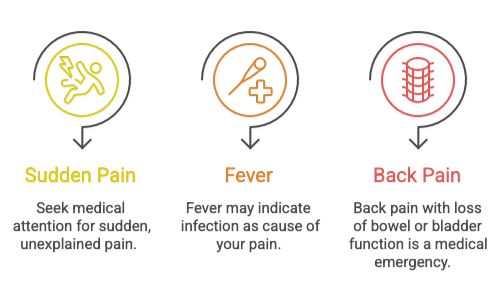
Acupuncture is amazing for pain relief. But its not magic. It’s also not the right treatment for all pain. Here are some instances when your GP or A&E may more appropriate than the acupuncture clinic..

  • New onset of unexplained pain with fever or temperature
  • Back pain and loss of control of bowel and/or bladder function
  • Sudden onset pain with nausea, dizziness, rapid pulseAcupuncture tends to be very effective for chronic pain and is recommended by NICE for treatment of primary chronic pain. The general rule is that if you get a sudden onset of new pain, with or without accompanying symptoms its best to get it checked out by your Dr first or go to A&E, especially if it’s unusual  and unexplained.

Link Between MRI results & Pain

August 5, 2026/0 Comments/in Pain/by Tim W

The link between MRI Results and Pain

If you have a flair up of acute back pain you want to know whats going on and you want it treated, preferably with some form of MRI or X-ray.

But, numerous studies have now cut the link between MRI results and back pain. Ninety percent of 70 year olds in a 2015 study involving MRI had damage to the discs in their spine. Yet none of these patients had back pain. If you think that’s an inevitability of ageing you’d be right. But this ageing starts young – 52% of 30 years olds in this study had disk damage also.

This isn’t a fringe study either. One of the first studies looking at MRI findings and pain was carried out in 1995 by the New England Journal of Medicine. It took 98 healthy, pain free people and MRI’d their backs. Again, 52% presented with disk protrusion or some level of degenerative change in the spine.

The British Association of Spine Surgeons agree “Magnetic Resonance Imaging Scans (MRI scans) give a very clear picture of the structure of the spine. It does not tell the doctor why the spine is painful. In 85% of patients we are unable to say why back pain occurs” (http://www.spinesurgeons.ac.uk/…/the-spine-and-mri…)

So If Not MRI, then What?

if you’re in your 50’s or 60’s and have an MRI it would be unusual for you not to have an MRI report that mentioned some degenerative changes in the spine. This isn’t a reason to worry. If you have back pain, often it can be more informative to check range of movement, strength and sensitivity to pressure on all the structures in and adjacent to the area of pain. Acupuncture treatment can frequently alleviate the pain.

What To expect From Acupuncture Treatment

Outcomes for treatment can vary. Acupuncture is a treatment tailored to the individual . An individuals circumstance affects the duration and outcome of treatment. I have treated some patients with recent onset (acute) back pain and resolved it within 3 treatments. At the other end of the spectrum I have treated patients with significant nerve damage. With these patients, acupuncture is often an ongoing weekly treatment which manages the pain, rather than eliminating it.

These two patient profiles are outliers. Most patients I see typically need 4-8 sessions, depending on age, fitness, length of time with back pain and severity of symptoms. The general rule of thumb is that the younger, healthier and less time you have been suffering the quicker it is to treat.

Calendar Calendar Book Free 15 Minute Consultation

Harness The Power of Fascia to Ease Inflammation and Pain

March 30, 2026/0 Comments/in Pain/by Tim W

Fascia & Pain…

Until recently – the last couple of decades – fascia was the thing that surgeons cut through to get to the interesting bits. It’s cast aside to access and assess the state of internal organs, muscles, nerves, blood vessels and tendons. Fascia itself is a thin layer of connective tissue, like a sausage skin, that sits under the skin and holds everything together. Its everywhere, all through the body.

Superficial fascia sits just under the skin and contains nerve fibres that detect pressure, temperature and movement. There’s also a deeper layer – usefully called deep fascia – which binds muscle, organs, blood vessels and more. This fascia is rich in fibres that sense position and movement (proprioception) and pain.

Fascia And Nerves

Fascia is an important part of our structure. Not something to be ignored to get to the big prizes of muscle and internal organs. Most human fascia contains approximately 250 million nerve endings. Roughly the same as you’ll find in skin. If you suffer from chronic pain the number of these nerve fibres that sense pain can grow from approximately 4% to 15%, which may explain why its so hard to treat chronic pain. Its thought that chronic inflammation causes the proliferation of these nerve fibres.

Fascia/ Back Pain Connection?

If you go to your doctor with back pain you’ll more than likely get a diagnosis of “non-specific” lower back pain. This is the majority diagnosis – approximately 85% of lower back pain is diagnosed as non specific in the UK. Non-specific is a technical term meaning “we’re not quite sure what’s going on”.
The number of nerve fibres can actually increase in chronic pain, making it more painful. Additionally the fascia itself can stiffen by up to 20%, just like a muscle tightening when injured. Initial research suggests that the sympathetic nervous system (responsible for the fight or flight mechanism) may trigger inflammation in the fascia, causing it to stiffen and compound the problem.
Could it be then that fascia is responsible for a large part of the 85% of non-specific lower back pain? Scientifically this can’t be answered yet, buy maybe. Its worth at least exploring a little more…

Harness The Power of Fascia

1. Stretch. Stretching can help the local fascia release and help to reduce pain. Initial research also suggests that stretching may have more widespread effects; reducing systemic inflammation in the body. Inflammation is a key component of many modern diseases; cancer, diabetes, auto-immune disease, depression.
2. Meditate. Stress and the ensuing overactivity of the sympathetic nervous system can cause inflammation of fascia and pain. Try to switch off the fight or flight mechanism by joining a yoga or meditation class, find space in your day to just “be”, share problems with close friends. Anything that you find truly relaxing.

3. Therapy. Acupuncture and massage can both help. There is evidence to suggest that many acupuncture channels or meridians map the main fascial networks in the body.

If you’d like to see if acupuncture couldk help your fascia pain click here to book a free 15 minute consultation.

Risks of Long Term Ibuprofen Use

March 27, 2026/0 Comments/in Pain/by Tim W

Risks of Long Term Ibuprofen Use
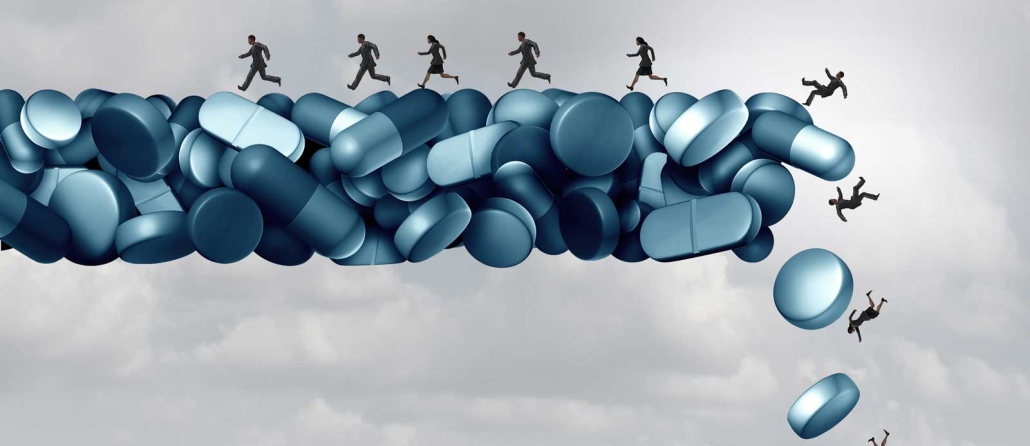
People Running away from Pills

Almost everyone at some point has taken ibuprofen to alleviate pain. I took it last 2 years ago. I had a nasty earache brought on by swimming in polluted seas. Not really being a medication kind of person I was, naively, blown away when it worked. I only took it sporadically for a week or so. It made me twitchy thinking about the potential side effects.
Ibuprofen is one of the most well-known Non-Steroidal Anti-Inflammatory Drugs (NSAIDs), alongside others such as aspirin and naproxen. NSAIDs are estimated to be responsible for up to 30% of drug related admissions to hospitals. Here are some of the reasons why:

1. Gastrointestinal Issues: NSAIDs can irritate the lining of the stomach and intestines, leading to ulcers and bleeding. This risk is higher in people with a history of gastrointestinal problems or those taking high doses of NSAIDs over a long period. To mitigate this risk a Proton Pump Inhibitors (PPI) such as omeprazole may be prescribed. Proton Pump Inhibitors have been implicated in potential malabsorption of nutrients including vitamin B12, vitamin C, calcium, iron and magnesium. In addition, taken long term there are studies to suggest they may increase the risk of gastric cancers.
2. Cardiovascular Risks: Prolonged use of NSAIDs, especially at high doses, has been associated with an increased risk of heart attack, stroke, and other cardiovascular events. This risk may be higher in individuals with pre-existing heart conditions or those at risk of cardiovascular disease. NSAIDs can also affect the kidneys ability to regulate fluid and electrolytes leading to higher blood pressure and affecting some blood presssure mediaction such as ACE inhibitors and Beta Blockers.

3. Kidney Damage: NSAIDs can impair kidney function, particularly in susceptible individuals such as the elderly or those with pre-existing kidney disease. Long-term use may lead to chronic kidney disease or failure. Its rare but NSAIDs can also cause liver damage.

4. Asthma Exacerbation: NSAIDs can worsen asthma symptoms in some individuals, leading to increased frequency and severity of asthma attacks.

I’m in no way saying don’t take NSAIDs, but it’s important to be careful. Follow the recommended dosage and duration of treatment, and consult your GP if you have any concerns. Its also worth considering alternative pain management strategies.

Facsia & Back Pain

March 20, 2026/0 Comments/in Pain/by Tim W

Fascia & Back Pain…

Couple stretching back muscles

The Specific reason for your non-specific back pain?

If you go to your doctor with back pain you’ll more than likely get a diagnosis of “non-specific” lower back pain. This is the majority diagnosis – approximately 90% of lower back pain is diagnosed as non specific. Non-specific is a technical term meaning “we’re not quite sure what’s going on”.
The number of nerve fibres can actually increase in chronic pain, making it more painful. Additionally the fascia itself can stiffen by up to 20%, just like a muscle tightening when injured. Fascia itself is a thin layer of connective tissue, like a sausage skin, that sits under the skin and holds everything together. Its everywhere, all through the body.

Superficial fascia sits just under the skin and contains nerve fibres that detect pressure, temperature and movement. There’s also a deeper layer – usefully called deep fascia – which binds muscle, organs, blood vessels and more. This fascia is rich in fibres that sense position and movement (proprioception) and pain.

Fascia And Nerves….

Fascia is an important part of our structure.  Most human fascia contains approximately 250 million nerve endings. Roughly the same as you’ll find in skin. If you suffer from chronic pain the number of these nerve fibres that sense pain can grow. Studies in rats have suggested the amount of nerve fibres may almost triple, which may explain why it can be so difficult to treat chronic pain. Its thought that chronic inflammation causes the proliferation of these nerve fibres.

Initial research suggests that the sympathetic nervous system (responsible for the fight or flight mechanism) may trigger inflammation in the fascia, causing it to stiffen and compound the problem. Could it be then that fascia is responsible for a large part of the 85% of non-specific lower back pain? Scientifically this can’t be answered yet, but maybe.

To find out how acupuncture can help stubborn, chronic back pain click here.

Acupuncture For Knee Pain

March 12, 2026/0 Comments/in Pain/by Tim W

Acupuncture For Knee Pain

knee pain treatment

If you’re over 45 and complain of activity related pain, with minimal morning stiffness, according to NICE, you can be given a diagnosis of osteo-arthritis of the knee by your GP – sometimes even over the phone. (https://www.nice.org.uk/…/ng226/chapter/Recommendations…). The subsequent treatment approach endorsed by NICE consists mostly of exercise, weight loss and medication where appropriate.

So What Can You do to Help Your Knee Pain?

If the pain is mild and a doctor has been consulted to rule out serious issues, modifying movement is the first thing to try. Work out how much exercise can be completed before pain kicks in, then make sure to keep exercise or movement just below that threshold. To increase endurance and strength the exercise frequency can increase – two times a day rather than once a day for example – whilst keeping all activity under the pain threshold.

Also work out the movements that hurt the knee. Quite often pivoting to a new direction whilst walking can cause knee pain. The knee is a hinge joint with only small capacity for rotation. Get to know these movements and try to avoid them in the short term.

What if Nearly All Movements Are Painful?

If you’re limited to only a handful of yards or minutes on your feet then you’re functionally comprised. You can’t do the things you need to do. Then you need to seek an intervention to stop the potential slide into chronic pain. This is when you need to seek out a professional to assist you on your journey. I love treating knees as they are simple joints that respond well to treatment.
By relieving pain you can engage in the one thing that most forms of knee pain need – activity to strengthen the quads. With more exercise, blood flow is improved. Your mood will likely improve as you move more and feel less pain. So the virtuous cycle of rehabilitation starts. Improved pain levels improve ability to exercise and strengthen quads. Improved mood can lower perception of pain and then increase likelihood of stepping out the door to exercise. And so the virtuous cycle continues on a potential pathway to recovery.
If you’d like to see if acupuncture can help your knee pain, why not schedule a free 15 minute consult

How Acupuncture Treatment Works

January 22, 2026/0 Comments/in Pain/by Tim W

How Acupuncture Treatment Works

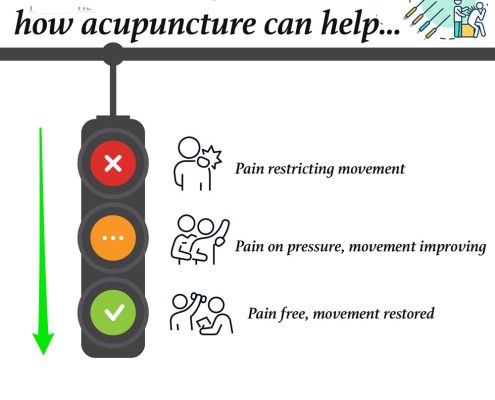
Acupuncture treatment for pain progresses in a reasonably predictable pattern from the red light phase of crippling pain through to the green light of getting your life back…

Traffic light system for acupuncture

  • The red stage of treatment. Pain is so acute that movement is problematic. And the pain may be impacting things you used to enjoy – sports, going out, mundane tasks at work or in the house. Acute or chronic its important to get your pain treated to stop it progressing. The earlier you catch it, the easier and quicker it is to treat.
  • The amber stage of treatment. As treatment progresses, pain levels drop, movement improves and many activities that were previously problematic become possible again. The pain may have gone, but often pressure on the previously painful area elicits pain. It’s important not to drop treatment too early as this latent pain can lurk, just waiting to be triggered again.
  • The green stage of treatment. The end game of treatment. Normal movement is restored. The area is no longer sensitive to touch or pressure. Previously painful activities can be enjoyed pain free.

How long it takes to progress from red to green, depends on numerous factors; age, health, chronicity of pain, mental health.
Acupuncturte doesn’t just work for pain, its also very effective at treating headaches and migraine and helping to ease stress and anxiety.

When Plantar Fasciitis Treatment Fails…

January 22, 2026/0 Comments/in Pain/by Tim W

When Plantar Fasciitis Treatment Fails…
baby feet

The characteristic pain of plantar fasciitis hits when you first get up. Foot down on the floor and ouch! you know about it. The pain tends to ease as you get going and the tissue warms up. It is a pain that is easy to define because it hurts so much in one place – just in front of the heel on the underside of your foot. A change in exercise or training habits can trigger it, as can a change in footwear or standing for prolonged amounts of time.

Plantar Fasciitis can be a difficult condition to treat because its stubborn and oftentimes it isn’t even plantar fasciitis at all but something else causing the pain on the underside of your foot or heel. Tight muscles on the lower leg can refer pain onto the heel and underside of the foot, nerves can get trapped as they make their way under the foot and poor circulation can all create issues similar to plantar fasciitis. Some of these potential causes are explored below:

Calf Muscles

The calf muscles (soleus and gastrocnemius) run down the lower part of the leg and insert into the heel via a common tendon – the achilles tendon. Tightness in either the gastrocnemius or soleus can refer pain into the heel. This is likely a problem if you stretch your calf and feel pulling in the back of the leg, especially if it refers lower down to the heel.
Pain is often worse in the morning. Overnight, most people sleep with feet slightly pointed – putting the calf muscles in a contracted position. As you get up and stand on the foot the calf muscles stretch triggering the pain after a night of rest.

Flexor Hallucis Longus

A long name for the muscle that pushes (flexes) the big toe down. This is the movement just before your foot leaves the ground when running or walking– the toes pushes down to help propel you forwards.
If flexing your toe against resistance (place finger under big toe whilst pushing it away from you) replicates your pain this is likely your culprit. The pain is typically felt running underneath the foot on the big toe side.

Its a common pain for ballerinas who have to regularly push up on to point (tip toes). Also if you over-pronate as a runner you end up putting excessive force through the big toe as it takes the brunt of the force as you push off to propel forwards.

Tibialis Posterior

This muscle runs up the inside of the leg and helps to invert the foot – pulling the inside of the foot up. This muscle is strongly stressed when running – particularly with over pronation as the muscle is stretched. In the acute phase (first few weeks) the muscle becomes inflamed. Left untreated and the original stressor still present, chronic cases lead to degeneration of the muscle or tendon. Pain can be felt on the inside of the ankle running under the inside of the foot (where the muscle inserts) in the instep.

Tarsal Tunnel Syndrome

There’s a thick ligament on the inside of the ankle – running between the ankle and the achilles tendon on the back of your ankle/ foot. Tendons, the tibial artery and posterior tibial nerve all run under this ligament. The area under this ligament can become congested, sometimes from scar tissue from repeated injury. This can compress the nerve and refer pain into the arch/ instep of the foot.
This needs treating quickly. Leaving any nerve compression for a long period of time may lead to permanent nerve damage, resulting in chronic weakness, numbness or pain.

Medial Calcaneal Nerve

The nerve which detects sensation in your heel and bottom of foot in the area where plantar fascitis is found is the medial calcaneal nerve. By modulating this with acupuncture we can reduce intensity of plantar fasciitis.

Heel spurs & Plantar Fasciitis

Plantar fascia runs on the underside of the foot, connecting the toes to the inside aspect of the underside of the heel. It’s fibrous and acts like a spring when pushing upwards off the foot. Damage to this fascia is typically caused by overuse.

Repeated over time the continual trauma near the heel causes the body to create a bony protrusion, known as a heel spur. This is the bodies way of trying to protect an over-stressed area.
Its tempting to think that the heel pain is coming from the heel spur, but according to some studies over 50% of patients who have heel spurs removed still suffer the pain (Surgical Treatment of Calcaneal Spurs – A Three Year Study, J AM Pod Med Assc, 1991:81:68-72)– because the pain originated in the damaged plantar fascia. The heel spur was a symptom of the plantar fascia, rather than the cause of the pain.

In longstanding cases of plantar fasciitis there is a high prevalance of necrosis of the tissue around the heel, due to poor blood flow from the medial plantar artery. This artery can be impinged by the muscle which moves the big toe outwards and downwards (abductor hallucis longus). Excess strain can be placed on this muscle when the big toe points inwards excessively (as can occur with bunions), or with excessive pronation of the foot (which stresses the big toe through excessive flexion forces).

How Can Acupuncture Help?

Given the multiple presentations of what can apparently be just plantar fasciitis, a thorough assessment is necessary prior to treatment, where I asses range of movement, strength and get a full history. Treatment times can vary from as little as 3 treatments for recent onset in a fit and healthy patient to 10-12 treatments for patients who have long standing pain and are in relatively poor health.

Why You Need To Stretch

January 22, 2026/0 Comments/in Pain/by Tim W

Why You Need to Stretch…

womana dn dog stretching together
We’re becoming less flexible. A study between 1966 and 2012 of American schoolchildren has shown that they’ve become less flexible, probably from a lack of activity and a more sedentary lifestyle. Its only since the invention of chairs that us humans have sat. Previously we rested by squatting on our haunches.

Stretching may be an unnecessary part of maintaining mobility in old age. Generally remaining active seem to be just as useful. The interesting part of stretching lie in the more fringe research. A research in 2018 of over 1,000 Japanese men aged 35-59 showed that the stiffest participants had the stiffest arteries and more plaque in their arteries. This was independent of physical fitness levels (https://bmjopen.bmj.com/content/8/1/e019370). A different study in Texas was looking to prove that strength training improved arterial flexibility. In reality strength training had no impact, whereas stretching improved arterial flexibility by 23% (https://pubmed.ncbi.nlm.nih.gov/18391640/ ).

Why might this be? Well athersclerosis is an inflammatory condition. When you’re stretching you’re stretching not just muscle but fascia as well. Studies on rats have shown that stretching fascia has the surprising effect of releasing anti-inflammatory chemicals called resolvins.

And there are a lot of diseases that have a root in inflammation. Inflammation is a key component of many modern diseases; cancer, diabetes, auto-immune disease, depression.

So get stretching or join that yoga class it may be that it will do you more good than just remaining bendy into old age.

Hiltons Law and Joint Pain

January 22, 2026/0 Comments/in Pain/by Tim W

Hiltons Law And Joint pain

When joint pain starts it’s alarming. Is this years of overuse and abuse finally catching up? The start of a slide into degenerative arthritis? Cartilage damage, arthritis, maybe a replacement knee or hip in the offing?

An MRI, especially if you are middle aged and beyond will undoubtedly reveal some level of deterioration. Taking the knee as an example, 43% of over 40’s with no knee pain present with cartilage tears, and somewhere between 19% to 43% of over 40’s have no symptoms but scans reveal osteoarthritis (https://www.ncbi.nlm.nih.gov/pmc/articles/PMC6837253/). So if the pain isn’t in the joint itself what else could be causing the discomfort?

John Hilton – a British Surgeon – was considered one of the best anatomists in the world in his lifetime (1805–1878). He was born in 1805. In a series of lectures from 1860-1862 he conceived Hiltons law, which stated that any nerve that innervates a muscle also has a branch of that nerve that innervates the joint.

What that means in practice is that dysfunction in muscle can refer pain to the joint. Joint pain can frequently be treated by treating the muscle that overlies the joint. In the case of the knee joint, treating the quadriceps group of muscles affects the femoral nerve, which also innervates the knee joint. This means that I can frequently successfully treat knee pain by targeting adjacent muscles.

This law doesn’t just apply to the knee. Neck pain, shoulder pain, back pain can all be effectively treated by targeting adjacent muscles.

Page 1 of 212
Search Search

Recent Posts

  • What actually happens during an acupuncture session?
  • When NOT to Book an Acupuncture Appointment
  • Why is Back Pain so Stubborn
  • Link Between MRI results & Pain
  • Stubborn headaches that just won’t go… Unusual Headache Cures…

Recent Comments

    Archives

    • August 2026
    • July 2026
    • April 2026
    • March 2026
    • January 2026
    • October 2025
    • September 2025
    • August 2023
    • June 2017
    • September 2015

    Categories

    • Headache
    • Health & Immunity
    • Pain
    • Stress & Anxiety
    • Uncategorized

    Contact Details

    Gower Acupuncture
    26 Newton Road
    Mumbles
    SA3 4AX

    Tel: 07764 254881

    Email: tim@goweracupuncture.co.uk

    Follow me on Facebook

    Accesibility

    See our accesibility statement here

    Privacy Policy

    See privacy policy details here

    Sitemap

    • About Tim
      • Acupuncture Treatment Details
      • Testimonials
    • Contact
    • Cookie Policy
    • Home
    • News
    • Pain
      • Back Pain
      • Headache & Migraine
      • Stress & Anxiety
    • Pricing
    • Privacy Policy
    copyright - Gower Acupuncture 2026 - Enfold Theme by Kriesi
    • Link to Facebook
    Scroll to top Scroll to top Scroll to top
    Manage Consent
    To provide the best experiences, we use technologies like cookies to store and/or access device information. Consenting to these technologies will allow us to process data such as browsing behavior or unique IDs on this site. Not consenting or withdrawing consent, may adversely affect certain features and functions.
    Functional Always active
    The technical storage or access is strictly necessary for the legitimate purpose of enabling the use of a specific service explicitly requested by the subscriber or user, or for the sole purpose of carrying out the transmission of a communication over an electronic communications network.
    Preferences
    The technical storage or access is necessary for the legitimate purpose of storing preferences that are not requested by the subscriber or user.
    Statistics
    The technical storage or access that is used exclusively for statistical purposes. The technical storage or access that is used exclusively for anonymous statistical purposes. Without a subpoena, voluntary compliance on the part of your Internet Service Provider, or additional records from a third party, information stored or retrieved for this purpose alone cannot usually be used to identify you.
    Marketing
    The technical storage or access is required to create user profiles to send advertising, or to track the user on a website or across several websites for similar marketing purposes.
    • Manage options
    • Manage services
    • Manage {vendor_count} vendors
    • Read more about these purposes
    View preferences
    • {title}
    • {title}
    • {title}